
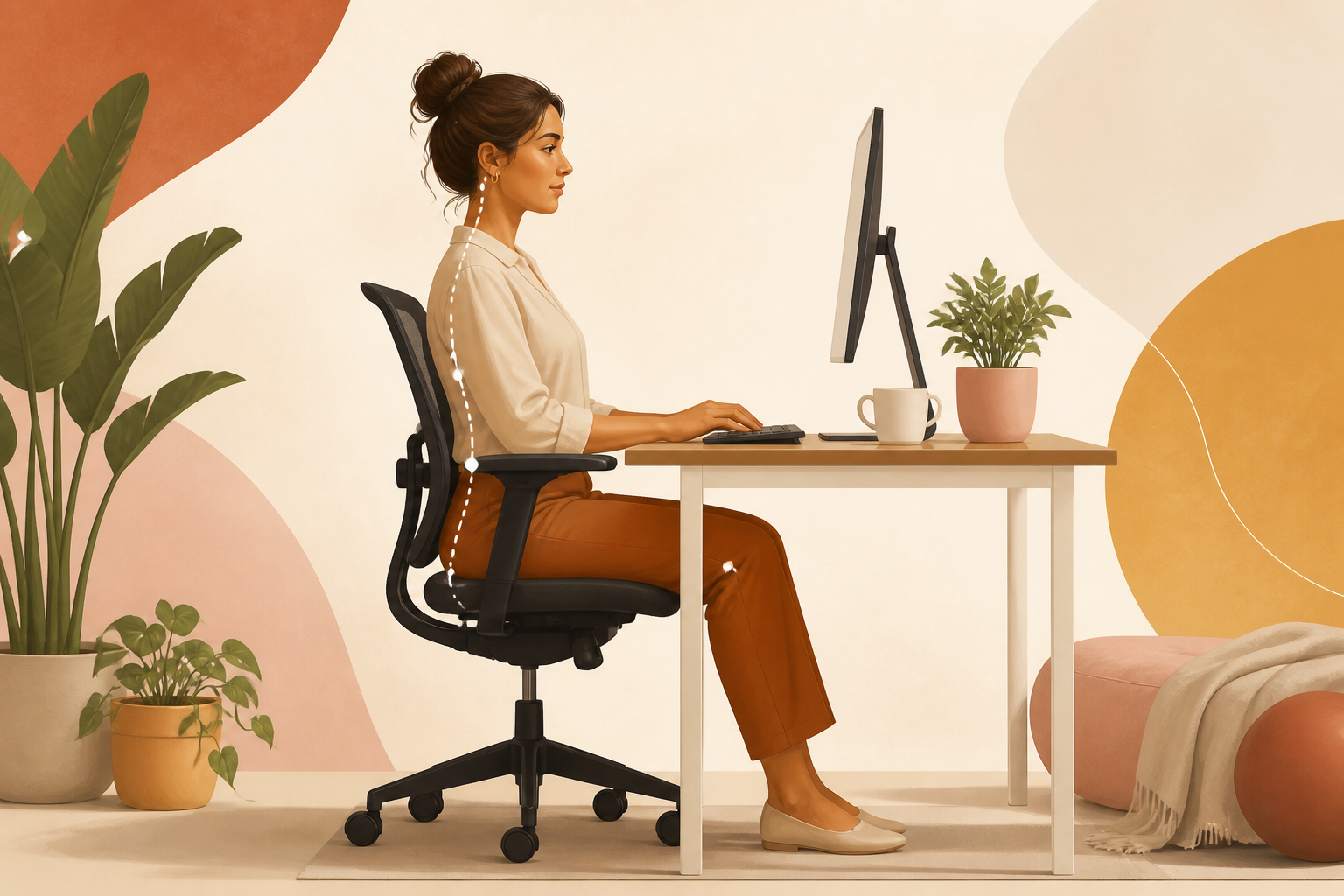
To improve your posture while working at a desk, you must align your ears, shoulders, and hips in a vertical line while maintaining the natural curves of your spine. This involves adjusting your chair height so your feet are flat on the floor, positioning your monitor at eye level, and taking movement breaks every 30 minutes to prevent muscle fatigue.
How should I set up my desk for better posture?
A proper ergonomic setup reduces the physical stress placed on your joints and muscles. Your chair should support the inward curve of your lower back, and your elbows should form a 90-degree angle when typing. If your feet do not reach the floor comfortably, use a footrest to avoid straining your lower back and thighs.
Most office workers spend between 7 and 10 hours a day sitting. Without the correct equipment placement, the body naturally slumps to compensate for gravity. The following table outlines the ideal measurements for a standard desk setup to help you improve your posture while working at a desk.
| Equipment | Ideal Position | Common Mistake |
|---|---|---|
| Monitor | Top third of screen at eye level | Placed too low, causing neck tilt |
| Keyboard | At elbow height, wrists neutral | Reaching upward or outward |
| Chair Height | Hips slightly higher than knees | Sitting too low, compressing hips |
| Feet | Flat on the floor or a firm rest | Dangling or tucked under the chair |
Why does sitting for long periods cause poor posture?
Sitting for extended periods leads to "postural fatigue," where the muscles responsible for holding you upright become tired and stop firing correctly. Over time, this causes the shoulders to round forward and the hip flexors to shorten, which pulls the pelvis out of alignment and creates a permanent slouch. Research suggests that muscle activity in the legs drops significantly after just 20 minutes of static sitting.
When you sit, the pressure on your spinal discs is roughly 40% to 90% higher than when you are standing. This increased load can lead to chronic discomfort if the muscles in your core and upper back are not strong enough to support the weight of your torso. Understanding health and wellness principles involves recognising that the human body is designed for frequent movement rather than static endurance.
What exercises help strengthen posture muscles?
Strengthening the posterior chain—specifically the upper trapezius, rhomboids, and glutes—is essential for maintaining an upright position. Exercises like "Chin Tucks" and "Scapular Squeezes" help counteract the forward head position common in office environments. Aim to perform these movements at least three times per week to see a measurable difference in your sitting comfort.
- Chin Tucks: Sit tall and gently tuck your chin towards your chest without looking down. This strengthens the deep neck flexors.
- Scapular Squeezes: Pull your shoulder blades back and down as if trying to tuck them into your back pockets.
- Glute Bridges: Lying on your back and lifting your hips helps wake up the muscles that become inactive during long bouts of sitting.
- Planks: A strong core provides the foundation for the spine, reducing the tendency to lean on the desk for support.
Incorporating these movements into your personal development routine can prevent long-term musculoskeletal issues. Consistency is more important than intensity; five minutes of daily stretching is often more effective than one hour-long session once a week.
How do I remember to sit up straight throughout the day?
Relying on memory alone is rarely successful because your brain focuses on your work tasks rather than your spinal alignment. Use external cues, such as digital timers or physical "anchors" in your environment, to remind you to check your position. Many people find success using the "20-80-2 rule": for every 30 minutes, sit for 20, stand for 8, and move or stretch for 2.
You can also use life hacks like setting a phone alarm or using a browser extension that blurs your screen every hour. These forced breaks allow your tissues to rehydrate and your muscles to reset. When you return to your seat, you are more likely to consciously adopt a neutral spine position.
Is a standing desk better for my posture?
A standing desk is a useful tool, but it is not a complete solution for poor posture. Standing for too long can lead to lower back strain and varicose veins, just as sitting for too long leads to stiffness. The benefit of a standing desk comes from the variety of movement it allows rather than the act of standing itself.
If you use a standing desk, ensure your monitor remains at eye level. Shift your weight from foot to foot frequently. Most experts recommend a ratio where you spend no more than 30 to 45 minutes standing for every hour of work. Maintaining a balance is a core part of wealth knowledge base health concepts, as physical longevity supports long-term productivity.
Does footwear affect how I sit at my desk?
Footwear plays a significant role in your pelvic alignment, even while seated. Wearing high heels or shoes with significant elevation at the heel can tilt the pelvis forward, increasing the arch in the lower back and leading to strain. For the best results, wear flat, supportive shoes or work in socks to ensure your feet can rest naturally on the floor.
When your feet are flat, your weight is distributed evenly across your sit-bones. This provides a stable base for your spine. If you find yourself crossing your legs, try to uncross them every 10 minutes, as crossing the legs rotates the pelvis and puts uneven pressure on the sacroiliac joints.
Frequently asked questions
How high should my monitor be?
The top of your monitor screen should be level with your eyes so that you are looking slightly downward at the centre of the display. This prevents you from tilting your head up or down, which reduces strain on the cervical spine. If your monitor is not adjustable, use a dedicated stand or a stack of sturdy books to reach the correct height.
Is it bad to slouch occasionally?
Occasional slouching is not inherently damaging, as the spine is designed to move through various ranges of motion. The problem arises when slouching becomes your default position for several hours a day, leading to permanent changes in muscle length and joint mobility. Frequent changes in position are more important than maintaining a "perfect" rigid posture all day.
Will a posture corrector harness help?
Posture harnesses are generally not recommended for long-term use because they do the work for your muscles, which can lead to further weakening. They may provide a sensory reminder to sit up, but they do not address the underlying muscle imbalances. It is more effective to build the necessary strength through targeted exercise and ergonomic adjustments.
How long does it take to fix years of bad posture?
While you may feel relief from tension within a few days of improving your setup, changing long-term postural habits usually takes 6 to 12 weeks of consistent effort. This timeframe allows for soft tissue adaptation and the strengthening of postural muscles. You can track your progress by noting how long you can sit comfortably before feeling the urge to slouch.