
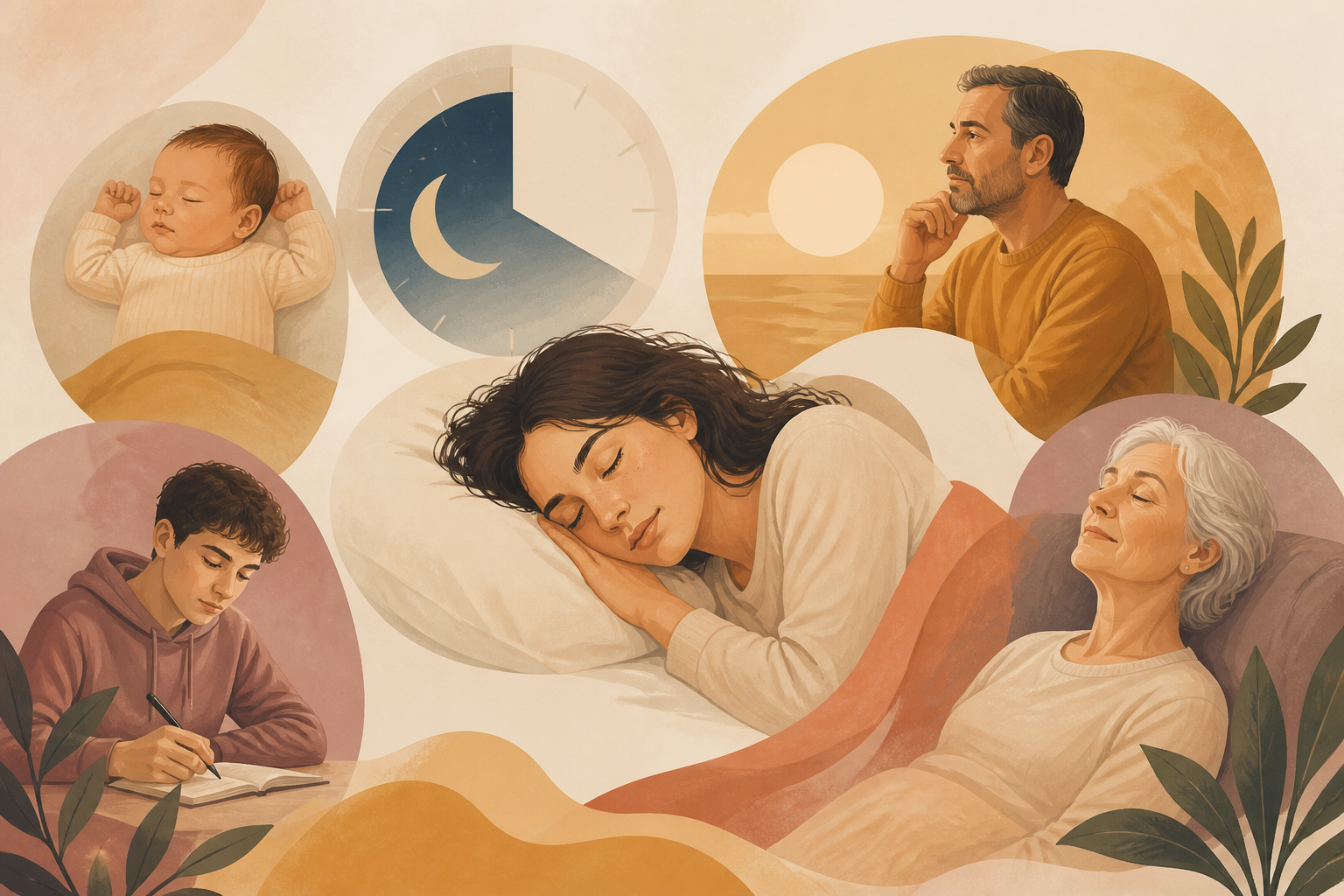
Most healthy adults require between 7 and 9 hours of sleep per night to function at their best. This duration allows the body to complete the necessary cycles of light, deep, and REM sleep required for physical repair and cognitive processing. While individual needs vary slightly, sleeping fewer than 7 hours on a regular basis is linked to various long-term health risks.
How much sleep do people need at different ages?
The amount of sleep you require changes significantly as you move through different stages of life. Infants and children need substantially more sleep because their brains and bodies are developing at a rapid pace. As we reach adulthood, the recommended duration stabilises, though the quality of sleep often becomes harder to maintain as we age.
According to general health guidelines in the UK, the following ranges are recommended for different age groups:
| Age Group | Recommended Sleep Duration | Acceptable Range |
|---|---|---|
| Infants (4-12 months) | 12 to 16 hours | Includes naps |
| Toddlers (1-2 years) | 11 to 14 hours | Includes naps |
| Children (6-12 years) | 9 to 12 hours | Consistent schedule needed |
| Teenagers (13-18 years) | 8 to 10 hours | Often delayed by puberty |
| Adults (18-64 years) | 7 to 9 hours | The standard benchmark |
| Seniors (65+ years) | 7 to 8 hours | May feature earlier waking |
It is worth noting that while older adults might sleep less at night, their actual biological requirement for rest does not decrease significantly. Instead, they may find it harder to stay asleep for long periods, leading to fragmented rest or daytime napping. You can find more practical advice on managing daily routines in our life-hacks section.
Why is the 7-to-9-hour range so important?
This specific window is necessary because the brain does not just "turn off" when you close your eyes. It moves through distinct 90-minute cycles. Each cycle consists of three stages of non-rapid eye movement (NREM) sleep and one stage of rapid eye movement (REM) sleep. Your body needs several of these cycles to perform different maintenance tasks.
During deep NREM sleep, the body releases growth hormones and repairs tissues. This is the stage where the physical "heavy lifting" happens. REM sleep, which becomes longer in the later half of the night, is crucial for memory consolidation and emotional regulation. If you consistently sleep only 5 or 6 hours, you are likely cutting off the longest periods of REM sleep, which can lead to irritability and poor concentration.
Maintaining a healthy sleep schedule is a core part of health-and-wellness. Without it, the brain cannot effectively clear out beta-amyloid, a waste product associated with cognitive decline. This process, managed by the glymphatic system, is primarily active during deep sleep.
Can you train yourself to need less sleep?
The short answer is no. While you can habituate yourself to feeling tired, you cannot change your biological requirement for sleep through practice or willpower. Research indicates that people who are chronically sleep-deprived often report that they feel "fine," but when put through objective cognitive tests, their performance is significantly impaired.
A tiny percentage of the population possesses a rare genetic mutation (specifically in the DEC2 gene) that allows them to function perfectly on 6 hours of sleep. However, for everyone else, "getting by" on less rest results in a mounting sleep debt. To understand more about building better daily routines, you can browse our personal-development guides.
What are the signs that you are not getting enough sleep?
If you are unsure whether your current 6 or 7 hours is sufficient, your body usually provides clear indicators. Feeling the need for a caffeine boost to start the day is a common sign, as is the "afternoon slump" around 2:00 or 3:00 PM. While some energy dip is natural due to circadian rhythms, extreme fatigue suggests a deficit.
Other common signs of insufficient sleep include:
- Falling asleep within 5 minutes of hitting the pillow (healthy sleep onset should take 10 to 20 minutes).
- Depending on an alarm clock to wake up every single morning.
- Feeling noticeably more impulsive or prone to snacking on high-sugar foods.
- Finding it difficult to focus on a single task for more than 10 minutes.
- Micro-sleeps, which are brief moments of spacing out during the day.
If you recognise these behaviours, it may be time to reassess your evening routine. Small adjustments to your environment and behaviour can significantly improve the quality of the hours you do get. Consistency is key; going to bed and waking up at the same time every day, even on weekends, helps regulate your internal clock.
How does sleep affect your physical health?
Sleep is a pillar of physical health alongside diet and exercise. Long-term sleep deprivation is linked to an increased risk of type 2 diabetes, cardiovascular disease, and obesity. This is partly because sleep regulates the hormones ghrelin and leptin, which control hunger and fullness. When you lack rest, ghrelin levels rise and leptin levels fall, making you crave calorie-dense foods.
The immune system also suffers without adequate rest. During sleep, your immune system releases proteins called cytokines. Some of these cytokines help promote sleep and are needed in higher amounts when you have an infection or inflammation. Lack of sleep can decrease the production of these protective cytokines and infection-fighting antibodies.
For more information on how health impacts your broader life choices, visit the blog. Managing your physical health is often the first step towards better productivity and long-term stability.
Frequently asked questions
Is an 8-hour sleep requirement a myth?
The "8-hour rule" is a helpful average rather than a strict law. While most people fall into the 7-to-9-hour range, some individuals are naturally "short sleepers" or "long sleepers" due to their genetics. The key is how you feel during the day without relying on stimulants.
Can I make up for lost sleep at the weekend?
You can recover some of the immediate symptoms of fatigue by sleeping in on a Saturday, but you cannot fully compensate for the biological impact of a week-long deficit. Large shifts in your wake-up time can actually cause "social jetlag," making it harder to fall asleep on Sunday night and perpetuating the cycle.
What if I wake up several times during the night?
Briefly waking for a few seconds as you roll over is normal and often forgotten by morning. However, if you are awake for 20 minutes or longer, it disrupts your sleep architecture and reduces the time spent in restorative deep sleep. Improving your sleep hygiene, such as keeping the room at 18 degrees Celsius, can help reduce these disturbances.
Does a nap count towards my daily total?
Naps can provide a temporary boost in alertness and contribute to your total rest, but they are not a perfect substitute for long periods of nocturnal sleep. A 20-minute power nap is usually the most effective for a quick refresh without causing grogginess when you wake. For most adults, naps should be kept short and taken before 3:00 PM.