
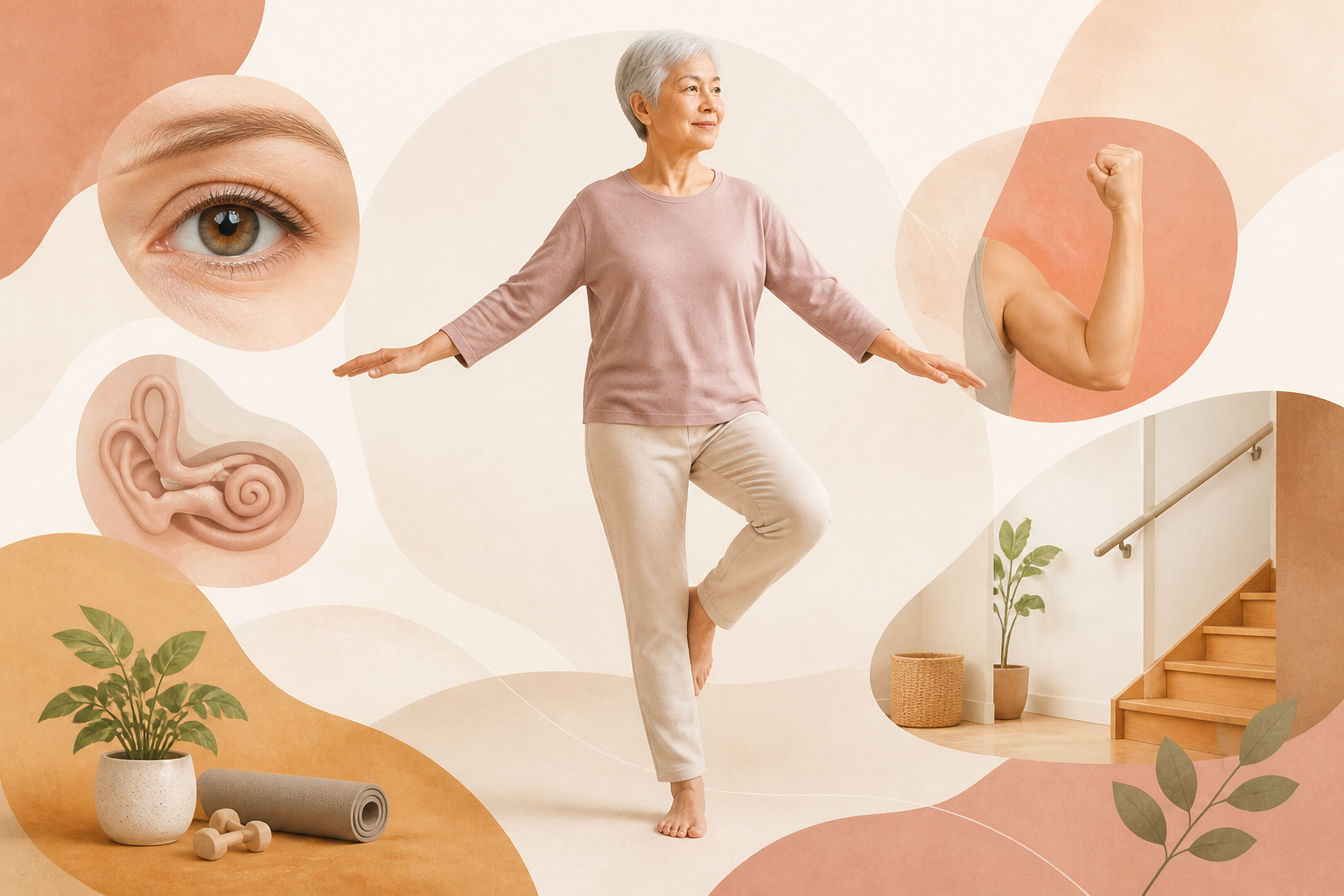
You can improve your balance by performing specific stability exercises, strengthening your core and lower body muscles, and addressing sensory factors like vision. Consistent training for 15 to 20 minutes, three times per week, helps the brain and body coordinate movement more effectively, significantly reducing the risk of falls and related injuries as you age.
Balance is not a single skill. It is a complex interaction between your brain, nervous system, and muscles. As we age, the systems that manage stability—the vestibular system in the ear, your eyesight, and proprioception in your joints—can become less efficient. Muscle mass also tends to decline by about 3% to 8% per decade after the age of 30. This physical change makes it harder to recover if you trip or stumble. Improving balance is a core part of health and wellness for long-term mobility.
Why does balance decline as we age?
Balance declines because the sensory systems providing feedback to the brain become less sharp, and muscle strength in the legs and core diminishes. Known as sarcopenia, this loss of muscle makes it difficult to maintain a steady centre of gravity during movement. Additionally, the signals sent from the nerves in your feet to your brain may slow down, meaning you react more slowly to uneven ground or obstacles.
Statistically, one in three adults over the age of 65 experiences a fall each year. These incidents are often the result of weakened ankles, poor eyesight, or a sedentary lifestyle. By understanding the biological causes, you can take specific steps to reverse these trends through targeted personal development of your physical capabilities. The goal is to keep the communication lines between your brain and your limbs open and fast.
How do you test your current balance?
You can test your current balance by performing a simple "Single Leg Stance" test to see how long you can remain stable without support. Stand near a sturdy chair or wall for safety, lift one foot off the ground, and time how long you can hold the position. Comparing your results to age-related averages can help you identify if you need to prioritise balance training in your daily routine.
The following table provides general benchmarks for how long a healthy adult should be able to stand on one leg with their eyes open.
| Age Group | Target Duration (Seconds) | Level of Concern |
|---|---|---|
| Under 40 | 45+ seconds | High stability |
| 40–49 | 40 seconds | Average stability |
| 50–59 | 35–40 seconds | Average stability |
| 60–69 | 25–30 seconds | Fair stability |
| 70–79 | 15 seconds | Higher fall risk |
| 80+ | 5–10 seconds | Significant fall risk |
If you cannot hold the position for at least five seconds, it is advisable to consult a healthcare professional. This test highlights where your stability sits currently and provides a baseline for improvement. You can find more foundational health information in our wealth knowledge base regarding long-term care and health costs.
Which exercises are best for improving stability?
The best exercises for stability are those that challenge your centre of gravity while strengthening the "postural muscles" in your legs, hips, and core. Incorporating these into your week helps build the functional strength required for daily tasks like climbing stairs or reaching for items on high shelves. You do not need a gym to perform these; most can be done in a living room using a chair for support.
- Heel-to-toe walk: Place the heel of one foot directly in front of the toes of the other foot, as if walking on a tightrope. Take 15 to 20 steps.
- Single-leg stands: Lift one foot and hold for 30 seconds. Switch sides. Do this while brushing your teeth or waiting for the kettle to boil.
- Sit-to-stand: Sit on a firm chair and stand up without using your arms for assistance. Repeat 10 to 12 times to build thigh strength.
- Calf raises: Stand behind a chair and rise onto your tiptoes. Lower slowly. This strengthens the ankles, which are vital for reacting to stumbles.
- Side leg raises: Lift one leg out to the side while keeping your back straight. This targets the hip abductors, which stabilise the pelvis.
Consistency is more important than intensity. Doing these movements for 5 minutes every day is often more effective than one long session once a week. These life hacks for physical health require no equipment but offer high returns on your safety and independence.
What role does footwear play in balance?
Footwear plays a significant role in balance by providing the necessary grip and sensory feedback from the ground to your brain. Shoes that are too loose, have very thick soles, or feature high heels can distort the information your brain receives about your position in space. Conversely, walking barefoot or in thin-soled shoes in a safe environment can actually improve proprioception by allowing the nerves in the feet to "feel" the floor more accurately.
For daily wear, look for shoes with a firm heel counter and a flat, non-slip sole. Avoid walking around the house in just socks, as this is a leading cause of slips on wooden or tiled floors. If you prefer not to wear shoes indoors, consider slippers with rubberised grips on the bottom. Ensuring your feet are well-supported is one of the easiest ways to apply practical how-to knowledge to your home life.
Can you improve balance through diet and lifestyle?
Diet and lifestyle contribute to balance by maintaining the muscle mass and bone density required to support your frame. Protein intake is particularly important; adults should aim for roughly 1.2 grams of protein per kilogram of body weight to combat age-related muscle loss. Sufficient Vitamin D and Calcium are also necessary to keep bones strong, reducing the likelihood of a fracture if a fall does occur.
Hydration is another factor that people often overlook. Dehydration can lead to dizziness and low blood pressure, both of which cause sudden instability. Aim for the standard 6 to 8 glasses of fluid per day. Furthermore, regular eye examinations are essential. If your prescription is outdated or you have developing cataracts, your brain will struggle to process the visual cues needed to keep you upright. Managing these factors is a key part of personal wealth management because preventing injury saves significant healthcare costs and time in the future.
How do I make my home safer for balance?
Making your home safer involves removing environmental hazards that could cause a trip while you are working on your physical stability. Even with perfect balance, a loose rug or a poorly lit hallway can cause an accident. Improving your environment is a practical step that works alongside your exercise routine.
- Remove trip hazards: Clear away clutter, loose cables, and throw rugs from high-traffic areas.
- Improve lighting: Ensure all stairs and hallways are brightly lit. Use motion-sensor nightlights for bathroom trips at night.
- Install grab bars: Adding a rail in the shower or next to the toilet provides an extra point of contact.
- Check floor levels: Use transitions or ramps for small height changes between rooms.
These adjustments create a "forgiving" environment. If you do have a moment of dizziness or a slight slip, the environment is designed to help you recover rather than making the situation worse. For more advice on managing daily tasks safely, see our life skills Q&A section.
Frequently asked questions
How long does it take to see improvements in balance?
Most people notice a measurable difference in their stability within 4 to 6 weeks of consistent practice. If you perform balance exercises three times a week, your neuromuscular pathways begin to adapt, making movements feel more automatic. Long-term changes in muscle strength usually take 8 to 12 weeks of regular activity.
Is Tai Chi good for improving balance?
Yes, Tai Chi is one of the most effective forms of exercise for balance because it focuses on slow, controlled shifts of weight. Studies have shown that regular Tai Chi practice can reduce the risk of falls by up to 50% in older adults. It encourages body awareness and strengthens the core and legs simultaneously.
Can dizziness be a sign of a balance problem?
Dizziness is often a symptom of an underlying issue affecting the systems that control balance, such as inner ear infections or blood pressure fluctuations. While exercise helps with physical stability, persistent dizziness should be checked by a doctor to rule out medical conditions like vertigo. Once the cause is treated, balance exercises can help recalibrate your coordination.
Do I need special equipment to improve my balance?
No special equipment is required to significantly improve your balance at home. While items like wobble boards or foam pads can add a challenge, simple movements like standing on one leg or heel-to-toe walking are highly effective. A sturdy chair and a flat floor are the only tools you need to get started.